
This year, the Canadian-based Haley-McCready Outreach and Development Fund provided one-time, start-up grants to four new agriculture development projects. All of the five Project Managers are new but three of these projects have our first four Project Managers who are Graduates of the new Hope Africa University (HAU) Agriculture Program.
- Empowering Vulnerable Women from Kayanza Province, Kabarore Commune at Caratsi Hill by Cultivating Crops and Breeding Pigs, Project Manager: Abbie RUBUMBA
- Cultivating White Potatoes and Cabbage and Breeding Pigs for Vulnerable Women from Gitunga Hill, Muyebe Zone, Kayokwe Commune, Mwaro Province, Project Manager: Alfred BIKORIMANA
- Supporting Vulnerable Women from Bujumbura Province, Isale Commune, Nyakibande Hill by Cultivating Corn and Beans and Breeding Goats, Project Managers: Christian NIYIBIKUNZE and Nelly SIBOMANA
- Cultivating Maize and Soya and Breeding Pigs for Vulnerable Women from Rugombo, Munyika II, Cibitoke Province, Project Manager: Mathieu NIYONKURU
For supporting the involvement of Graduates of the new HAU Agriculture Program as H-MODF Project Managers and supporting the connection of Graduates of the new HAU Agriculture Program with H-MODF Projects, we are grateful to Rector Victor BARANTOTA and Agriculture Program Head Cyprien NTUNZWENIMANA.
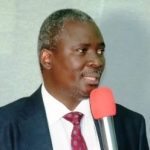
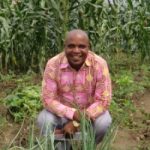
Designation of a Project in Memory of Burton Hamilton
In our last Newsletter, we announced that Burton Hamilton, one of the founding members of the Haley-McCready Outreach and Development Fund (H-MODF) Board of Directors, had resigned because of health reasons. Sadly, we now announce that Burton Hamilton died on August 24, 2023. Burton was a great supporter of social justice and the H-MODF and its poverty-alleviating agriculture development projects.

Burton freely shared his knowledge, skills, experience and wisdom. The Board of Directors is grateful for the significant and lasting contributions that Burton Hamilton made to the development of the H-MODF and the solid foundation that will continue to serve the H-MODF very well long into the future.
The Directors of the H-MODF have selected and designated one of our four new agriculture development projects as a special H-MODF project; a special designation made in honour and memory of Burton Hamilton.
We think this project is a good choice because it builds on our proven agriculture development project model that will allow the project and its association members to become self-supporting, self-managing, self-governing and self-sustaining long into the future. In addition, the Project Manager is a recent Graduate of the new Hope Africa University (HAU) Agriculture Program and, thereby, increases the chances that the beneficiaries will learn to use and benefit from modern more productive agriculture methods (see the project progress report below).
Project Progress Reports
The following reports below are based on written progress reports and recent onsite visits to the projects.
In memory and honour of Burton Hamilton:
- Cultivating Maize and Soya and Breeding Pigs for Vulnerable Women from Rugombo, Munyika II, Cibitoke Province, Project Manager
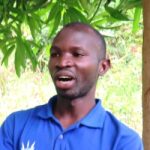
Project Manager: Mathieu NIYONKURU, Graduate of the new HAU Agriculture Program
Introduction
Poverty-stricken, vulnerable women are not valued in Burundian society. They can hardly get food for themselves and their children. They cannot afford school fees and medication for their children. They are marginalized because of their limited economic power.
The aim of this project is to gather poor and vulnerable women into an association and mentor them about crop cultivation, animal husbandry and microfinancing. The beneficiaries of the project are expected to become self-supporting, self-managing, self-governing and self-sufficient.
An Emerging Association
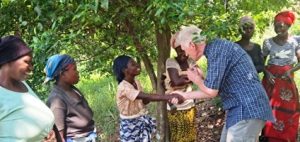
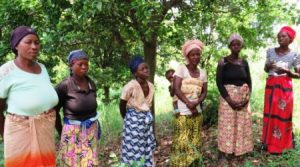
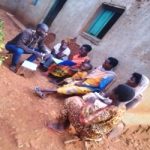
The Project Manager collaborated with the local administration in order to register the association and select the beneficiaries of DUHINDURE KAZOZA association which literally means “Change Our Future.” The Project Association has eight female members; 20-45 years of age.
The officers were elected: the President, the Deputy President and the Secretary. The Project Manager holds capacity development meetings three times per month.
The members find both the Association and this project very important. One of the beneficiary said: “I am very interested by this association. The teachings that I get are very helpful. They are helping me to change my mindset on how I can contribute in my development. I consider the association members as my family.” Another woman said: “The association is creating another important time in helping me to leave isolation. I am learning daily through shared experiences with my friends in the association. The association has helped us to build our capacities.”
Crop Cultivation
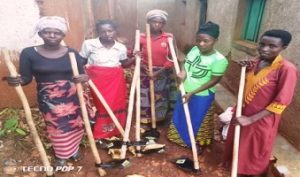
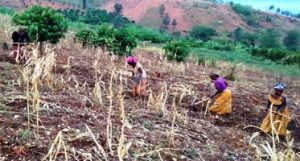
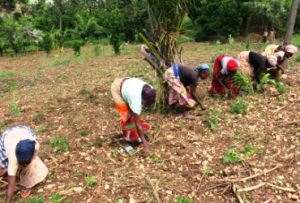
Once the money for crop cultivation became available, the Project Manager and beneficiaries opened a bank account and rented two fields for cultivating maize (corn) and soya beans using modern more productive methods. The grant money has been used to purchase hoes, manure, fertilizers and selected seeds of maize and soya beans.
Breeding Pigs
The project plans to purchase and breed pigs for the Project Association and the Association Members. As required, the critical crop cultivation function must become self-supporting before the second part of the grant money can be used to purchase pigs.
Microfinancing
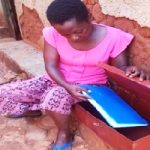
The Association bought a box with three locks for keeping the microfinancing money secure. Some initial capital from H-MODF was put in the microfinancing box for start-up purposes. Each member contributes 500 BIF for capital and 100 BIF for Social Assistance per week. The microfinancing money is used for loans for income-generating activities and the loans will be repaid with 5% interest. Some loans have already been made.
Concluding Comments:
Although we are still at the start, we see that this project will contribute to the life of beneficiaries (vulnerable women) in different ways like: to change their mind set, to cohabite with others, to learn how to do well through modern crop cultivation, to receive a harvest to feed their families and to do the small income-producing businesses which will help them to meet the needs of their families.
We thank the Founder and Program Director, Dr. John McCready and Program Coordinator, Rev. Dieudonné IRAMBONA for their contributions in order to change vulnerable lives. May God bless you.
End of Onsite Visit
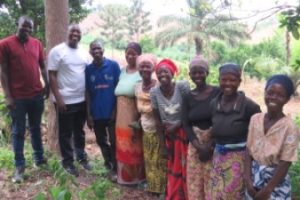
Project Manager Prosper, Program Coordinator Dieudonne, Project Manager Mathieu and Beneficiaries at the close of a very good onsite visit.
- Empowering Vulnerable Women from Kayanza Province, Kabarore Commune at Caratsi Hill by Cultivating Crops and Breeding Pigs
Project Manager: Abbie RUBUMBA, HAU Graduate and HAU Employee

Introduction
This agriculture development project is located at Caratsi Hill, in Kabarore Commune, Kayanza Province. It is based on empowering poor, vulnerable women by cultivating crops, breeding pigs and microfinancing in order to improve their lives. The Project Association is expected to invest the one-time, start-up grant to become self-supporting, self-managing, self-governing and self-sustaining.
The project is very fortunate because it has a very well connected and involved Graduate of the new HAU Agriculture Program. Yes, Christine NININAHAZWE is the daughter of the Project Manager and she lives nearby the project and is committed to contributing to the project by introducing modern more productive agriculture methods.
Developing the Association
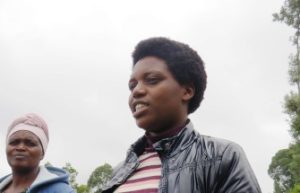
The association is named MUKENYEZI IKANGURE which means “Awakening Women.” The association was set by selecting 10 vulnerable women. They are widows and women from the least families. The selection was done with the help of the local administration. As they know their people, the Chief of the colline brought ten names of the beneficiaries who are faithful, and willing to work together. After the selection, the associates elected the officers of the association who are in charge of facilitating the association that is registered at the colline level. The officers are the President, the Vice-president and the Secretary-treasurer. Their main duties in the association are to manage the association, report to the Project Manager, plan and prepare the weekly meeting, facilitate the association members for the different daily issues, coordinate the daily activities of the association and represent it before the local administration.
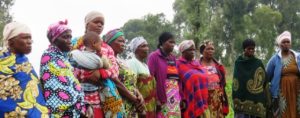
Nowadays, the association is working well. They hold a meeting on every Monday for planning the next activities. The significance of working together as an association is highly relevant. They are collaborating in working together and supporting each other. Also, during the weekly meetings, every woman is given a chance to give her own opinion before decision-making.
Cultivating Crops
The Project Association members have rented two large fields for cultivating maize (corn). With guidance from Christine on modern more productive methods, the members prepared and planted the corn themselves (notice the nice clean lines of corn). Now, the crops are off to a very good start.
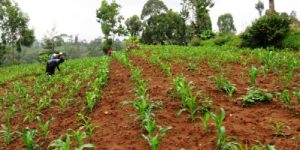
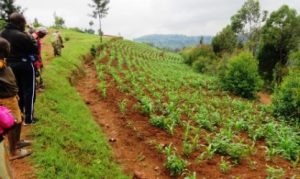
As it is mentioned in association rules, the crops will be shared into 3 shares: 50% of the harvests will be shared by the association members; 40% of the harvest will be sold for continuing self-supporting crop cultivation activities and 10% will be saved for seeds. The association is planning to cultivate potatoes during the next season.
Breeding Pigs
As the Project Association is new, the breeding of pigs will follow when the crop cultivation function has become self-supporting. It is hoped that the purchase of pigs will be done in December.
Microfinancing
Drawn from the grant money, the microfinancing started by having 80,000 BIF as the initial capital. In addition, each member contributes 500 BIF per week. The microfinancing money is being used to provide loans for income-generation and other activities. The loans must be repaid with a small amount of interest.
Concluding Comment:
We cannot end this report without thanking the Almighty God who uses Dr. John McCready to support many people to improve their lifestyle financially. May God strengthen him in all aspects of life.
Saying Goodbye
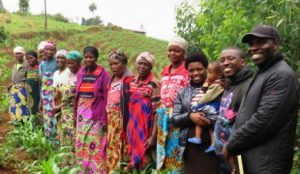
The beneficiaries, HAU Agriculture Graduate Christine, Program Coordinator Dieudonne and Project Manager Abbie smiling at the end of the onsite visit.
- Cultivating White Potatoes and Cabbage and Breeding Pigs for Vulnerable Women from Gitunga Hill, Muyebe Zone, Kayokwe Commune, Mwaro Province
Project Manager: Alfred BIKORIMANA, Graduate of the new HAU Agriculture Program
Introduction
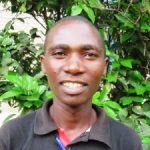
Before starting to write the report, it was for me an immeasurable joy to be in the family of H-MODF Project Managers. Since joining the H-MODF family, I found the opportunity to meet with the people of my knowledge. This was of great benefit not only for the beneficiaries but also for me who found the opportunity to deepen my knowledge because the learning that never stops.
The project involves developing an association, followed by cultivating crops, breeding pigs and microfinancing. The crop cultivation and microfinancing activities have already begun and the breeding of pigs is expected to begin in the new year.
Developing an Association
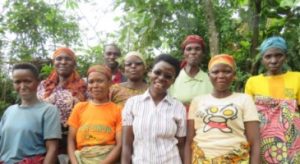
The project began by contacting the the local administration and they were encouraging and helpful. For the Project Association, we chose 8 vulnerable women and created a dialogue on the advantages of working together.
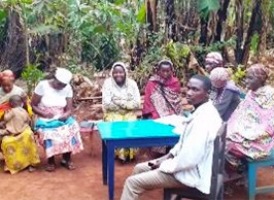
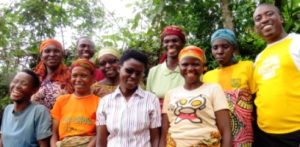
From this opportunity, we decided to share the implementation responsibilities in the project and we named the self-help project the “NDUZANKUDUZE ASSOCIATION” which literally means ‟Supporting Each Other.” The members elected their officers; a President, Secretary, Treasurer as well as an Advisor. The members signed their commitment agreements which interested the members so much by reassuring them that their project was founded.
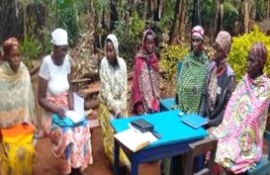
From an economic point of view, the money usable by the beneficiaries in the association “NDUZANKUDUZE” was donated by Haley-McCready Outreach and Development Fund. We used a sum of 28,000F for the purchase of usual materials for the survival of the association (notebook, pens, communication, etc.).
Cultivating Crops
After starting the association, the beneficiaries were committed to look for the field to start crop cultivation.
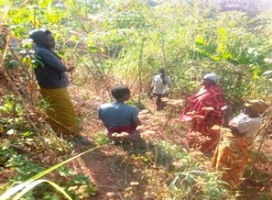
In the assembly, the members met and had a debate around the point concerning the cultivable land, which concluded with the decision to rent land for 5 years for a sum of 200,000 BIF per year, that is to say 1,000,000 BIF (this sum was paid in cash).
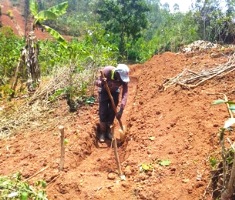
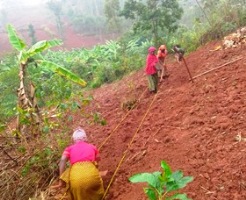
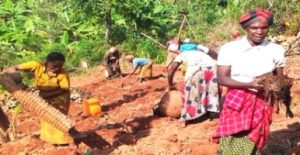
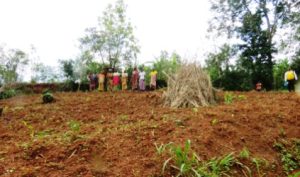
This land has a trapezoidal shape having a perimeter of 50m square or 1/2ha. For this land to be cultivated, the members made the decision to buy the compost, a rope, selected potatoes seeds and organo-mineral fertilizers. With all of the association members involved in the cultivation, the “NDUZANKUDUZE ASSOCIATION” now has a very well-sown field of potatoes with contour lines to protect the arable soil from erosion.
Microfinancing
Each of the 8 members of “NDUZANKUDUZE ASSOCIATION” contribute 500 BIF per week, meaning 2,000 BIF per month. They prefer to develop using “taxpayer” money on the condition that the one who uses it brings 5% of money taken per month as profit. Now, they have 32,000 BIF in their hands, but all the money for loans is currently taken by two members.
Concluding Comment:
Both the Project Manager and the beneficiaries are thankful to the Haley-McCready Outreach and Development Fund for the start-up grant. It helped both sides to extend their works and support each other. The beneficiaries are gaining a lot of skills in terms of crop cultivation, techniques and modern practices for crop cultivation which are quite different to the traditional methods.
Until the Next Time
- Supporting Vulnerable Women from Bujumbura Province, Isale Commune, Nyakibande Hill by Cultivating Corn and Beans and Breeding Goats
Project Managers: Christian NIYIBIKUNZE and Nelly SIBOMANA, Graduates of the new HAU Agriculture Program
The Project Managers have organized a Project Association. The project’s main functions will be cultivating crops, breeding goats and microfinancing. By the time this project received its first installment of money for starting crop cultivation, the most suitable and economical fields had already been rented by other farmers. To protect the precious development grant money, the start-up of the project is delayed until the next planting season which will be in January and February of 2024.
To invest in development that really works, please visit Donations – Haley-McCready Outreach and Development Fund (haley-mccreadyfund.ca)